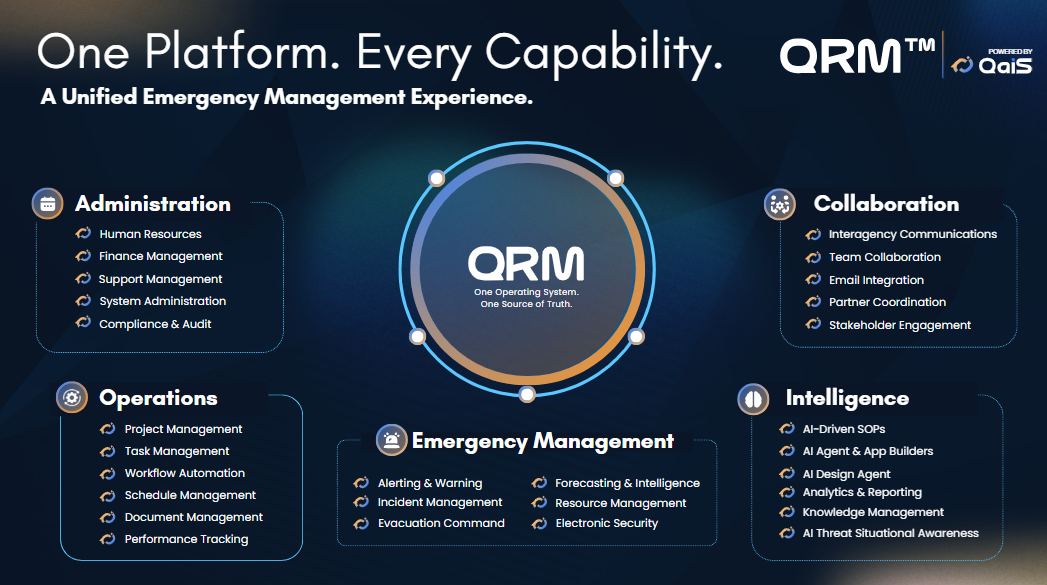
Most organizations run on eleven disconnected systems, one for alerts, one for inspections, one for training, one for the ledger, and a spreadsheet holding the rest together. QRM replaces the seams. Every module below writes to the same record layer, so a person, a site, an asset or an incident is entered once and understood everywhere.
This is the discipline HQE was built on. These seven modules share one roster, one geography, one incident record, so the person who checks in safe, the zone that was ordered to evacuate, and the alert that went out are all the same story, not three exports.
Ingests NWS, NOAA and IPAWS feeds continuously, correlates them against your sites and thresholds, and dispatches the alert, including out to physical sirens, without a human retyping a single field.
The audience-facing side of an incident, with a mobile app. Residents and employees see what's happening, where to go, and tap once to check in safe, and that check-in lands straight in the incident record.
Zone-based evacuation orders, shelter and route guidance, road closures, scheduled drills, and the post-action record written as it happens, so the after-action report isn't reconstructed from memory.
A common operating picture for the people running it: incident command structure, task assignment, duty staffing and live status across every open event, one console instead of a wall of unlinked screens.
Group rosters, responder accountability roll-call and muster, and per-recipient delivery tracking across in-app, SMS and voice. You don't just know a message was sent, you know who received it and who hasn't answered.
Authoritative US forecast products in one working view: NWS/NDFD fire weather, SPC convective and fire outlooks, and flood guidance, the same sources your emergency manager already defends decisions with.
The FEMA/NIMS ICS form library, native. View, fill and edit the standard ICS forms inside the incident they belong to, populated from data QRM already holds instead of a blank PDF on a shared drive.
Safety, compliance, money, people and pipeline. These are the departments that normally each buy their own vendor. In QRM they're one system, so a failed inspection can open a corrective action, pull the right certified technician, and hit the ledger, without leaving the record.
A pack isn't a different product, it's the same record layer with the objects, workflows and reports your sector actually uses. Turn one on and the rest of QRM already understands it.
Airfield operations built for the people who hold the certificate: daily inspections, movement-area conditions, wildlife and NOTAM workflow, FAA compliance evidence and the airport safety program in one file.
Patient registry and care plans through to the money: remote patient monitoring, a CPT billing ledger, telehealth visits, and an executive P&L rollup that reads from the same records the clinicians touch.
Jobs from first measure to signature, estimates and takeoff, material and labor build-up, e-sign proposals that convert into a scheduled crew and an invoice without re-entry.
Work orders, dispatch and technician scheduling with the certification and credential check built in, the tech assigned is the tech who's actually qualified and available.
Course authoring, cohorts, assessment and paid enrollment, for districts running compliance training and for institutions selling seats to the public.
Charging sites, charge points, session records and host accounts, utilization, uptime and settlement handled by the same ledger that runs the rest of the organization.
Because every module is first-party and shares one record layer, the agents don't need connectors to see your work. They read the same rows your team does, act through the same permissions, and every action they take is logged and attributable.
QaiS sits above every module: it reads the incident, the inspection, the ledger and the roster together, drafts the work, and executes it through the platform's own tools. It's how a single operator can run an event that used to take a room, and why the answer to "what changed and why" is always one query away, not one meeting away.
HQE Systems is both a software developer and a hardware manufacturer, an OEM and technology provider, not a reseller. That means the chain from detected event to audible warning is engineered end to end by one accountable party, with no vendor handoff in the middle of an emergency.
Keep what you own. Upgrade when you're ready.
QRM integrates with any software or third-party hardware you already run, so there is no rip-and-replace. Nothing is stranded, nothing is forced, and no capital budget has to be defended before you can start. When a legacy system reaches the end of its usefulness, you move that one piece to a modern AI-powered module or life-safety alert hardware, voluntarily, on your schedule.
Bring your current stack, your compliance obligations and your existing hardware to the call. We'll map what QRM integrates with, what it replaces, and what you should leave exactly where it is.